Two journeys. One market.
A participant's journey starts at the point of purchase and ends with a claim valued and pursued. A site's journey starts with one sentence at checkout and ends with a measurement on its own numbers. Neither journey costs the participant anything.
We are at the founding-site stage: choosing a small number of marketplaces for measured trials.
A buyer, seller or client on a covered site.
-
You transact on a covered site
The cover is stated at the point of purchase, so nobody finds it out later. The site has built it into its transaction flow, so every transaction there is covered. The site pays for it. You pay nothing, now or at any later stage.
Illustration: the cover line at checkoutReview your orderCalmly ResolvePlace orderThis transaction carries cover from Calmly Resolve. The site pays for it; you pay nothing. … Full wording
Illustration. Your site's name goes in place of "the site"; the wording is from an approved set.
-
Something goes wrong
You use the site's own dispute process first. Calmly takes no part while that process runs. Most disputes end there.
-
The site's process ends in a final refusal
The site routes the dispute to Calmly. It passes its own records of the transaction, with your authorisation: the transaction, the contract terms and the refusal history. Those records are the evidence for your claim. You gather nothing.
-
Your claim is checked against the admission rules
Calmly checks the public registers for the other party and checks the claim against the exclusions below. A check that cannot be completed means Calmly asks for more before it admits the claim.
-
An independent method values the claim
The method is a published, versioned standard. Both parties receive the same report at the same time. The report is yours to read and keep, whatever happens next.
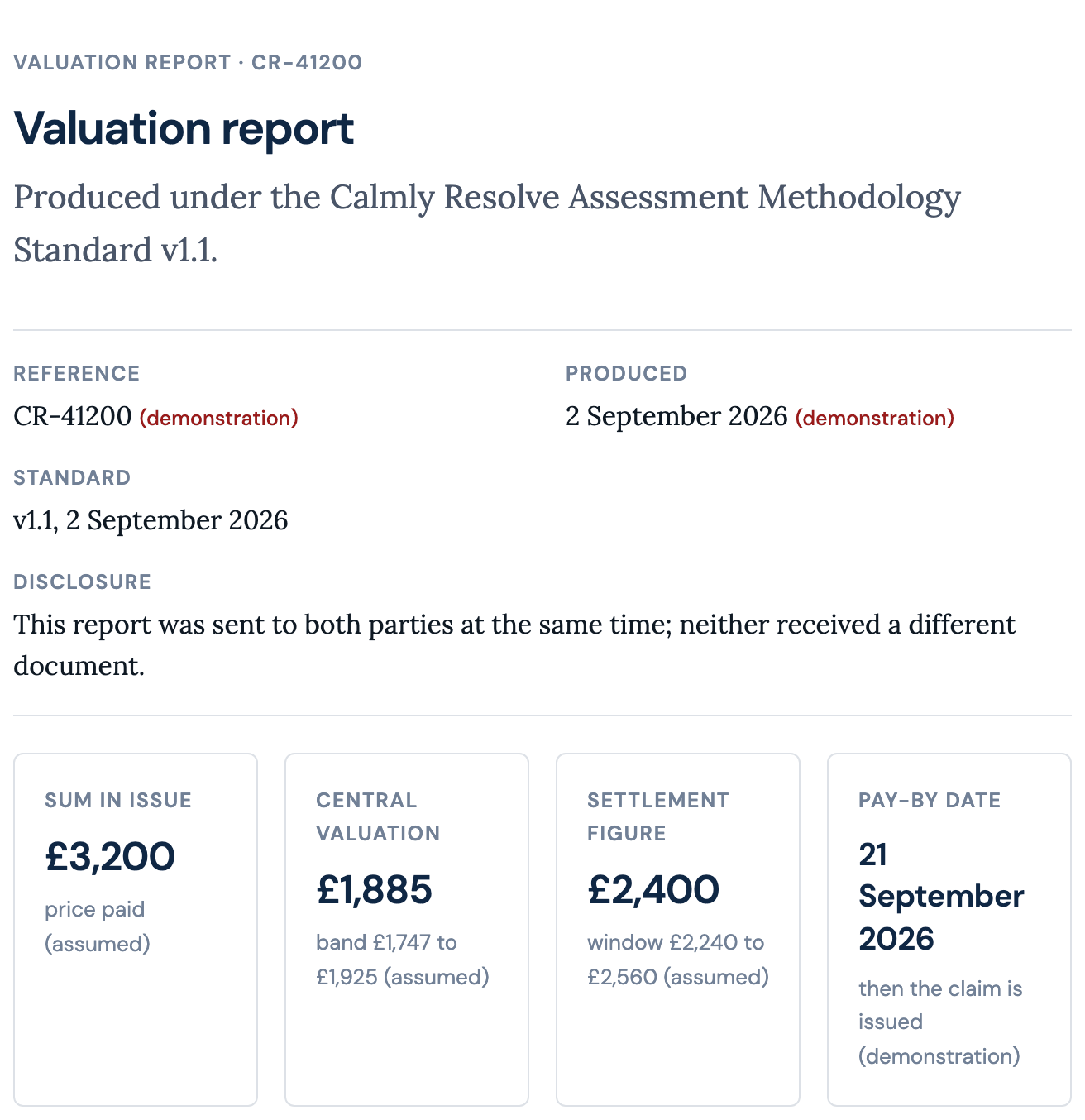
The report, as both parties receive it. Eight sections, in the order the standard sets, under a stated version. Product screen, pre-launch. Demonstration data; figures are assumptions.
-
The claim is taken on and pursued
Calmly takes your claim on at its valued price and pursues it. The other party gets one dated rule: pay by the date, or the claim is issued. You are paid from what it recovers. No fee is charged to you, and nothing is taken from your payment.
Once a committed buyer exists, you can sell the claim at its valued price instead. You may also decline and keep your claim.
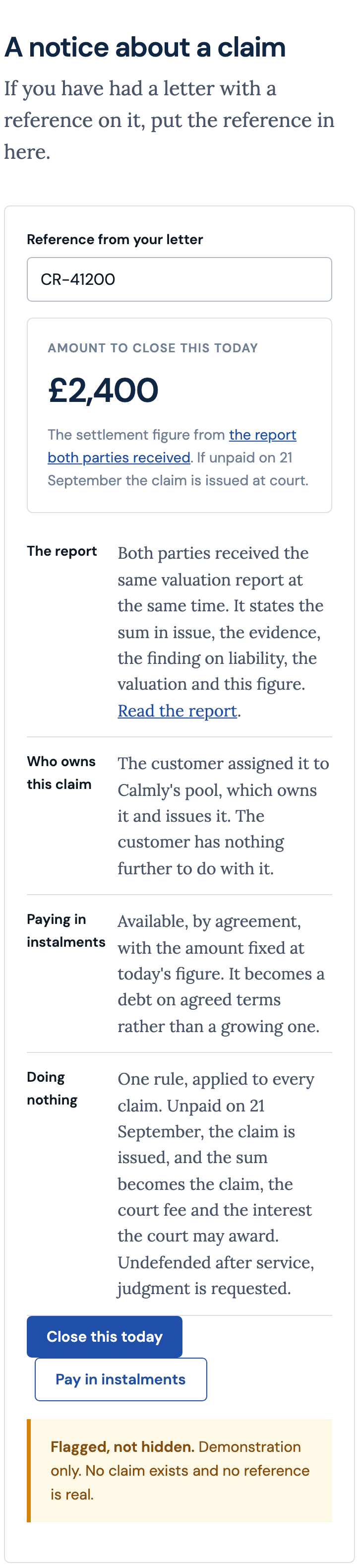
The notice the other party reaches from the letter. The settlement figure from the report, and the one dated rule. Product screen, pre-launch. Demonstration data; figures are assumptions.
What it costs you: nothing. Calmly does not decide your dispute and does not deal with the other party for you. Nothing is lent to you, and nothing is ever recovered from you. Calmly runs the market and is never the payer.
A marketplace or services platform.
Place the cover line at the moment a transaction forms, from an approved set. Route a dispute to Calmly only when your own process ends in a final refusal, and pass its records with the participant's authorisation. Send a monthly transaction count; during the trial, carry a random split between a covered group and an uncovered group.
Stated at purchase, in plain words.
Some disputes are routed and valued but not taken on. The cover says so at the point you transact. An excluded claim is still valued, and the report is still yours to keep.
-
The other party is insolvent, dissolved or being struck off
A claim against a business or person in insolvency, dissolution or strike-off when the dispute arises is not taken on. Calmly checks the public registers when the dispute arrives.
-
The claim is below the minimum value
A claim below £2,500 is routed and valued but not taken on. The minimum is an assumption; the first site's intake measures the size of arriving claims and sets whether it moves.
-
The claim is a kind this market does not take
The cover takes three kinds of claim. Marketplace goods: goods that are wrong, late or missing. Site services and money owed: work bought through the site, and money owed under a contract formed on it. Deposits and holdings: money held and not returned. Financial services and credit claims are outside this market. Personal injury claims are outside, including any claim with an injury element mixed in.
-
At launch, the other party is a sole trader or an individual
At launch, only claims against trading companies are taken on. A claim against a sole trader or an individual is routed and valued but not taken on, until the first trial.
-
Until committed money exists, the cover is conditional
No claim is bought unless committed money already stands behind it. Until that money exists, the cover is conditional, and the wording at purchase says so. Today, claims are valued and pursued, not bought.