One published standard. Both parties read the same report.
Every claim Calmly values is valued under the Calmly Resolve Assessment Methodology Standard. It is published, versioned and changed only under change control. Anyone can read it.

In outline. The standard has the detail.
The method prices each admitted claim from the profile's tree of the paths a claim of its kind can take: settlement before issue, settlement after, judgment, and collection. Three claim-level factors adjust the result. Solvency: the expected share of any agreed or ordered sum that can actually be collected. Evidence: how much the site's records shift the claim towards early settlement or towards litigation. Claim class: the fee schedule that applies, and whether the class is in the launch book at all.
At launch the factor values are set by judgement, within bands stated in advance. As cases resolve, predicted and realised recovery are published by tier, and the bands are revised under change control.
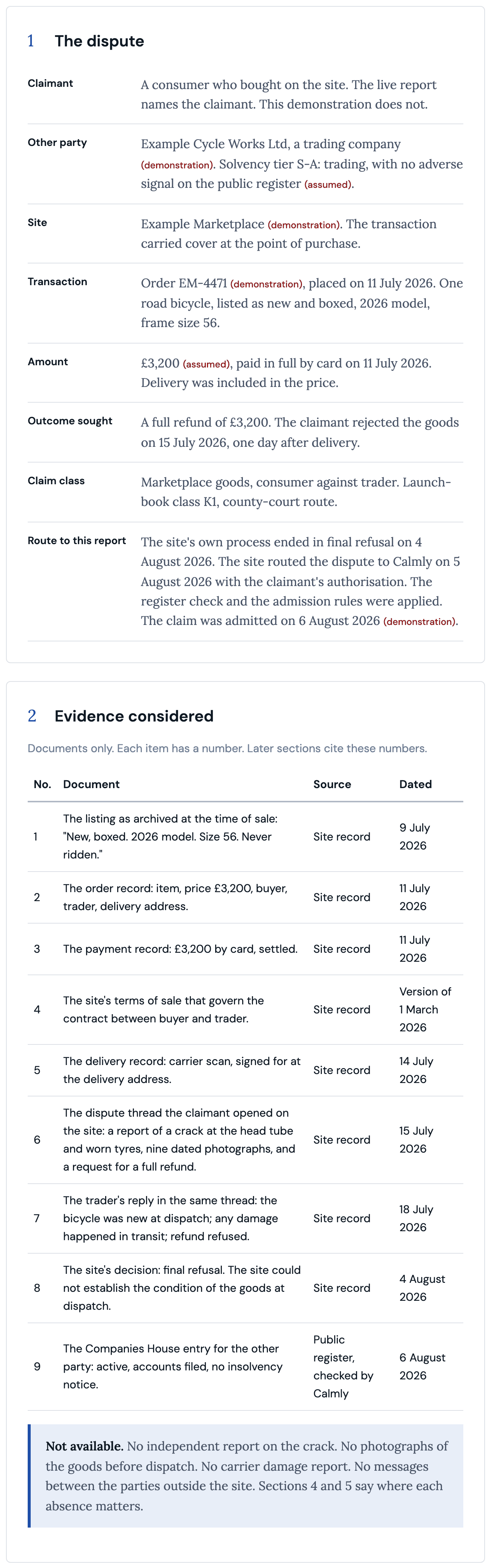
Illustration. The figures are examples.
- It does not promise an outcome. A valuation is an expected value under a stated method, not a prediction of what any one claim will recover.
- It does not decide the dispute. Calmly is not a judge or an arbitrator, and does not deal with the other party on the participant's behalf.
- Independence is in the standard, not in a signature. The method is public, so any report can be checked against it by anyone.
- It is not a forecast for any site. The method values claims. It says nothing about how many disputes a site will have, or what cover will do to its volume. The measured trial exists to find that out.
- Every resolved case enters the published accuracy record, from the first one.
The standard is the only independence statement we make.
We would rather you read the method than take our word for it. The full text, its version history and the change-control rule are public.
Calmly Resolve Assessment Methodology Standard v2.0 Jurisdiction profile EW-1